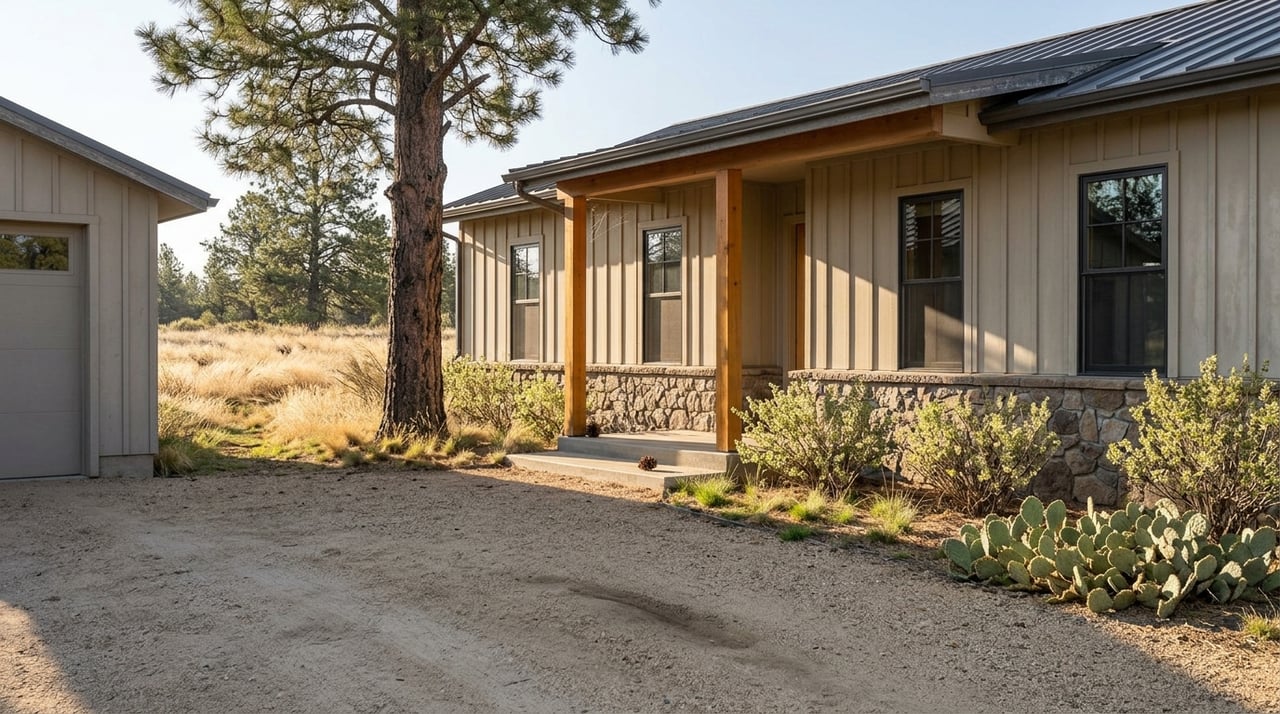
Would you guess that the mountain-resort county costs more in property tax than the quiet ranching county next door? Most buyers would. Most buyers would also be wrong once you look at Howard, Colorado.
Howard sits along U.S. 50 in Fremont County, 13 miles from Salida and 46 from Cañon City, the Fremont County seat. Because Salida and Buena Vista carry the mountain-market premium in most buyers' minds, Howard gets filed under "the budget alternative," the place you land if you want river frontage and a view of the Sangre de Cristos without paying Chaffee County prices. That shorthand isn't wrong about home prices. It falls apart the moment you look at what actually sets a Howard property owner's bill, because the line running through this town of fewer than 900 people does something buyers rarely check for before they write an offer.
A town split by more than a river
Howard is a census-designated place, not an incorporated town, so there's no town council setting local policy here. What there is instead is a boundary that runs southwest from the Arkansas River up into the Sangre de Cristo foothills within San Isabel National Forest, and that boundary doesn't respect the tidy idea of "Howard, Fremont County" that shows up on a listing sheet.
Nearly all of the Howard census-designated place falls inside the Cotopaxi RE-3 school district, based in Fremont County. A piece of it extends into the Salida R-32-J district, which is administered out of Chaffee County. Two homes a quarter mile apart, both with a Howard, CO mailing address, both plainly "in town" by any local's definition, can sit in two different school districts and two different county tax structures. The address won't tell you which side of that line a specific parcel falls on. The parcel record will.
That distinction sounds like a footnote until you're the one comparing two Howard listings and trying to figure out why they don't behave the same way once you run the numbers.
The rate that runs backward from what you'd expect
Here's the part that surprises people who assume Fremont County is simply the cheaper county because it's further from the resort towns. Public tax-rate data for Fremont County puts the median effective property tax rate at roughly half a percent of assessed value. The comparable figure for Chaffee County runs closer to three-tenths of a percent, noticeably lower, not higher.
This isn't a one-year anomaly. Colorado's Division of Property Taxation data placed Chaffee among the four lowest average county mill levies out of the state's 64 counties as of 2022, a position built on years of comparatively restrained levies from the county, its school districts and its special districts. Fremont County's combined levy structure runs higher across those same categories. The county with the ski-town reputation has, for years, quietly had the lighter tax hand.
That doesn't mean Chaffee County property owners are exempt from surprises. Chaffee County Assessor Janie Williams told The Mountain Mail earlier this year that a wave of 2026 bills landed higher than homeowners expected, not because the mill levy jumped but because a temporary state reduction that had lowered residential actual values by $55,000 for tax years 2023 and 2024 simply expired. As Williams put it, describing a system with three separate moving parts, none of them within a homeowner's control: "The rate is set by the state, the mill levies are set by the taxing authority like the county, hospital or water, but we give [properties] the value."
For a Howard buyer, that three-part structure matters in a very specific way. If your parcel or your child's assigned school district ties back to the Chaffee County side of that internal line, part of your bill calculates against a base rate that's historically run lower than the county next door. If your parcel sits fully in Fremont County, you're starting from a different number. Not a dramatically different one for a typical home, but different enough that "Fremont equals cheaper" isn't a rule you should assume without checking the specific parcel.
Why the cheaper story survives anyway
Part of why this myth sticks is that Howard home prices genuinely can run below comparable river frontage closer to downtown Salida, and buyers quietly conflate a lower purchase price with a lower total cost of ownership. Those aren't the same figure. A lower list price sitting under a fire protection district, a water conservation district and a school levy all stacked on top of the base county rate can close some of that price gap by the time the first tax notice arrives, since mill levies from every overlapping taxing entity add together rather than replacing one another.
The story also survives because Howard's own sales numbers are thin enough to support almost any conclusion you want them to. Earlier this year, one 30-day snapshot of Howard sales pulled from public listing data showed a median of roughly $577,000 based on just three closings, while a separate look at the broader pool of active Howard listings around the same time averaged well above that figure. Three closings in a town this size isn't a market signal. It's a sample small enough that the next single sale can swing the median by tens of thousands of dollars in either direction. Treat any one month's "Howard median" as a rough sketch, not a fact, and put your confidence instead in the structural details that don't reset every time a new sale closes.
What to check before comparing Howard to Salida or Buena Vista
If you're cross-shopping Howard against something closer to Salida or Buena Vista proper, skip the county-level comparison and go parcel by parcel:
- Which school district the specific parcel falls in, Cotopaxi RE-3 or Salida R-32-J, confirmed with the district office rather than assumed from the mailing address
- Which taxing districts actually overlap that parcel, since county, fire protection, water conservation and school levies stack, and the combination changes near any boundary
- What the most recent Notice of Valuation shows for that exact property, rather than a countywide average that may not represent your particular piece of ground
None of this shows up cleanly on a listing sheet. It shows up in the Chaffee County Assessor's parcel records and Fremont County's own assessor data, both public and both worth pulling before you get attached to a specific address.
Howard's appeal, the quiet stretch of highway between two larger towns, the river running past the back fence, the long sightline to the Sangre de Cristos, doesn't shift based on which side of a county line your driveway sits on. Your tax bill does. Knowing which side you're on before you make an offer is the difference between an ordinary closing and an unpleasant letter in the mail the following spring.
FAQ
How do I find out which school district a specific Howard parcel is in? Contact the Cotopaxi RE-3 district office or the Chaffee County-based Salida R-32-J district directly. The Howard CDP's boundary runs through the community itself rather than following a single road or the town's edge, so a mailing address alone won't settle it.
Does a lower countywide tax rate guarantee a lower bill on any given property? No. The county rate is one layer among several. Fire protection districts, water conservation districts and school levies each add mills on top of it, and which of those districts cover a specific parcel depends on exact boundaries a countywide average can't show you.
Why did Chaffee County tax bills rise in 2026 if the county has a historically low mill levy? A temporary state reduction that had lowered residential actual values by $55,000 for tax years 2023 and 2024 expired, pushing valuations, and some bills, higher even though the underlying mill levy structure remained comparatively low.
If you're weighing a property in Howard against something in Salida or Buena Vista and want someone to walk the parcel-level details with you before you write an offer, the team at First Colorado Land Office has spent decades sorting exactly this kind of county-line question for buyers across Chaffee and the surrounding valley. Get in touch today and we'll help you see past the countywide averages to what your specific address actually means.