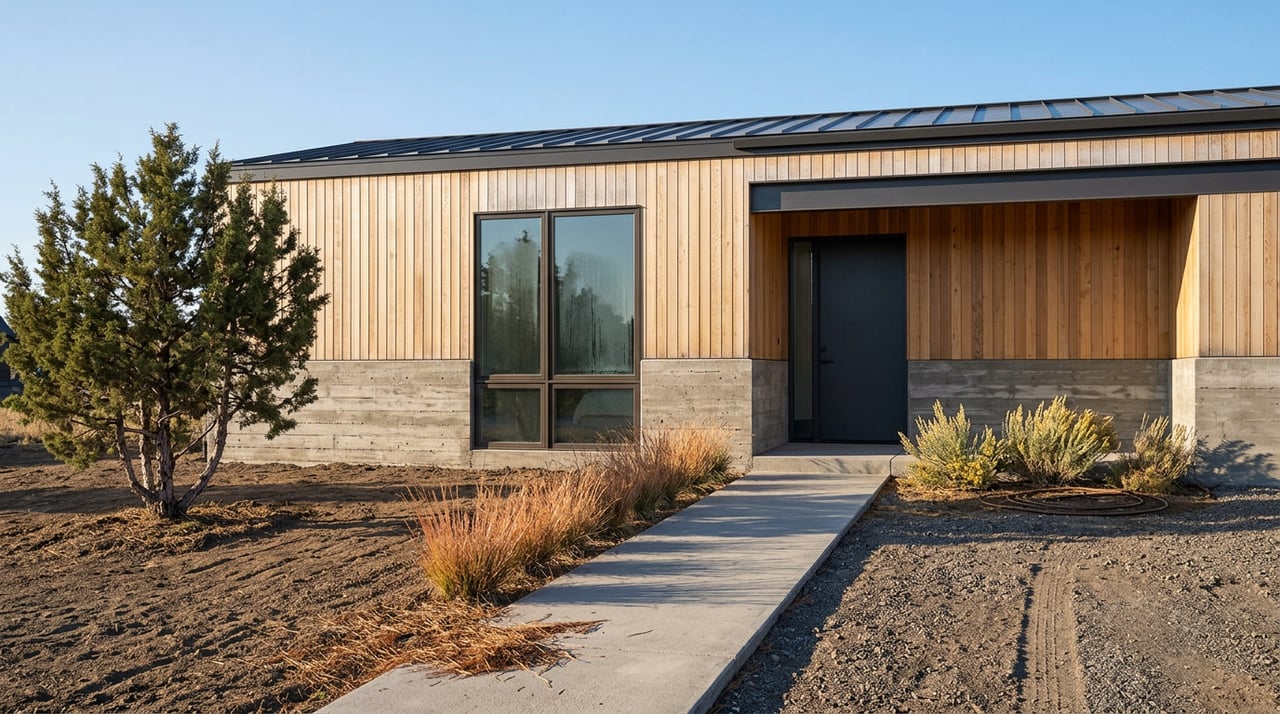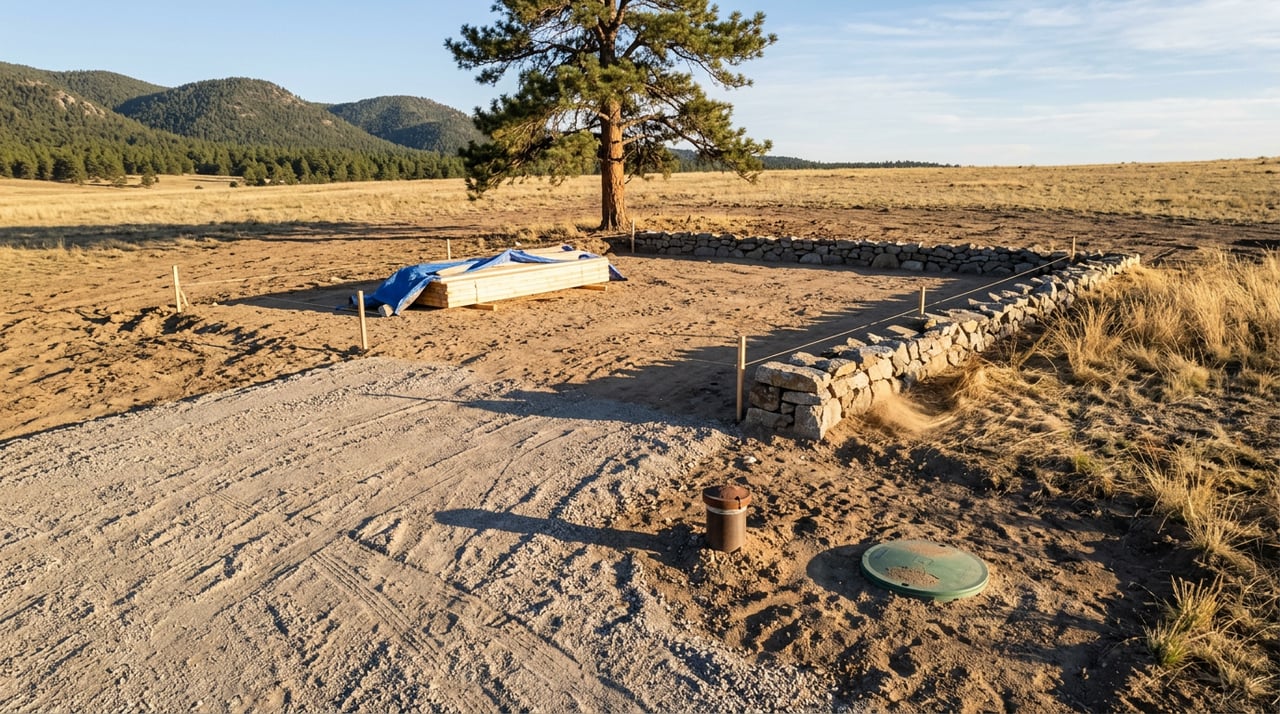
A buyer scrolling listings in Salida this fall will eventually land on two very different-looking deals. One is a fixer-upper cottage inside the historic core, walking distance to F Street, priced somewhere north of $600,000 for well under 1,200 square feet. The other is a 2.5-acre parcel out in a place like Cattle Creek Ranch, listed around $280,000, with sweeping views of the Collegiate Peaks and room to build exactly the house you want. On paper, the second one looks like the obvious win. More land, better views, less than half the price.
What that comparison leaves out is the part that shows up after closing, not in the listing. The in-town cottage already has a water tap and a sewer line running to the street. The Cattle Creek Ranch lot doesn't, and in Chaffee County that isn't a minor detail you handle later. It's a permitted, engineered project that local installers were still quoting at $35,000 to $50,000 for a basic system as of early this year, driven by the granite and clay soils and the often-deep water tables that define this stretch of the valley. Add a well, and in some spots the water table sits deep enough that drilling isn't practical at all, pushing buyers toward a hauled-water cistern instead. Price that in, and the gap between the "cheap" lot and the "expensive" cottage gets a lot narrower than the listing prices suggest.
That's the real story behind Salida's downtown-versus-everywhere-else price split. It isn't mainly about charm. It's about which parcels already have municipal water and sewer running to them, and how hard it has been, for years now, to extend that infrastructure to new ground.
What "cheaper" actually means on the county's edge
Salida's own market data backs this up in blunt terms: central, historic-core properties consistently command a premium over homes on the western edge of the city. The easy explanation is walkability. Salida carries a Walk Score of 73 and a Bike Score of 85, genuinely rare numbers for a mountain town this size, and most of downtown's dining and shopping is reachable without a car. That's real value, and it matters to buyers.
But walkability doesn't explain why a 2.5-acre lot at Cattle Creek Ranch costs a fraction of a small in-town cottage. Infrastructure does. In December 2022, Chaffee County commissioners advanced a sketch plan for the Cattle Creek Major Subdivision, an 18-lot parcel broken into pieces ranging from 2.47 to 8.45 acres, explicitly served by individual wells and on-site wastewater treatment systems rather than city utilities. That's not a flaw in the plan. It's simply what land outside city limits looks like here: more space, lower sticker price, and a construction budget that has to absorb the cost of building your own water and wastewater system from scratch, on soil that often requires the more expensive engineered version of that system rather than a basic one.
None of this means county land is a bad buy. It means the discount is a trade for a real, quantifiable cost that a buyer needs to price before comparing it to anything inside city limits.
The premium downtown isn't only about charm
Flip the comparison around and the historic core's premium starts to look less like a charm tax and more like a paid-off utility bill. Homes inside Salida's largest-in-Colorado National Historic District, and in newer in-town developments like Two Rivers, are already connected to the city's water and sewer system. That connection was built, financed, and maintained over more than a century of the town's existence. A buyer purchasing there isn't paying extra for character alone. They're paying for infrastructure that already exists, on a lot that doesn't require a $40,000 surprise before the foundation goes in.
Here's how that actually breaks down for a buyer weighing the two options side by side:
| Historic core / in-town (Two Rivers, downtown) | County edge / recently annexed (Cattle Creek Ranch and similar) | |
|---|---|---|
| Water and sewer | Connected to city system | Private well or cistern, individually permitted |
| Wastewater | City sewer line | Engineered septic system, county-permitted |
| Typical added cost before building | None, already connected | Roughly $35,000 to $50,000 for septic alone, plus well |
| Walk Score context | 73 citywide average, higher downtown | Car-dependent, no sidewalks |
| Zoning path | Already inside city limits | Often requires annexation to reach city utilities |
Why the edge of town doesn't just get annexed and hooked up
If the fix seems obvious, just annex more county land into the city and run pipe to it, the last few years of Salida city council meetings tell you why that hasn't happened quickly. On the west side of town, near Spruce Street and West Ouray Avenue, a developer first proposed annexing 15.06 acres back in 2010. Sixteen years later, in March 2026, the city council finally approved a rezoning on that parcel, and it came with a haircut: neighboring property owners forced a referendum that repealed the original R-3 High-Density designation, and the replacement R-2 Medium-Density zoning cut the maximum unit count from 96 down to 72. A project that took over a decade to reach council also ended up smaller than originally planned.
The city's own Vandaveer Ranch tells a similar story on a longer timeline. Salida bought the 192-acre ranch on the edge of town in 2004 for $3.2 million, a price that included senior water rights on the Tennessee Ditch, a deal one local official involved at the time later called one of the smartest purchases the city had made in years. What followed was over a decade of shifting visions for the land, a golf-course subdivision, a natural resources center, a concert venue, before a citizen-driven housing master plan finally took shape. Even a modest, privately built affordable-housing project just up the road, a 32-unit pocket neighborhood of duplexes proposed by local developers, still had to clear its own formal annexation petition, conceptual review, and multiple city council hearings before it won approval in 2019.
Both examples point to the same mechanism. New, utility-connected, in-town supply in Salida doesn't show up fast. Annexation is slow, contested, and often reduced in scope by the time it clears council. That scarcity is exactly what keeps the historic core's premium durable year after year, independent of whatever the national housing market is doing.
What this means if you're comparing two listings
Before treating a lower price per acre as a straightforward deal, a few questions do more work than the listing photos:
- Is the parcel inside Salida city limits, or in unincorporated Chaffee County? A Salida mailing address doesn't guarantee city utilities.
- Has a well ever been drilled nearby? A neighboring well log is a better predictor of depth and cost than anything in the listing description.
- Has the lot had a percolation test? Soil conditions determine whether you're looking at a standard septic system or a pricier engineered one.
- What's actually driving the discount? If it's genuinely a smaller, older, or less updated structure, that's a normal market difference. If it's the absence of a water tap and a sewer connection, that's a cost you're deferring, not avoiding.
None of this means county-edge land is the wrong choice. Plenty of buyers want the acreage, the privacy, and the ability to build exactly what they want, and they go in with eyes open about the well and septic budget. The point is simpler: the $280,000 lot and the $650,000 cottage aren't really being compared on the same basis until both prices include what it takes to get water running and wastewater leaving the property.
FAQ
Does buying inside Salida city limits guarantee I'm in the historic district? No. The historic district is a specific, mapped area within city limits. Plenty of in-town homes, including newer developments like Two Rivers, sit inside city limits and on municipal utilities without being subject to historic district design review.
Will the price gap between downtown and the county edge shrink as projects like the west-side rezoning move forward? It's reasonable to expect some new utility-connected supply to reach the market as recently approved projects get built, but the pace so far, over a decade for the west-side parcel and even longer for Vandaveer, suggests this happens in years, not months.
If I want acreage without the well and septic questions, are there any options? Ask specifically about lots that have already had utilities extended as part of an annexation, rather than raw county parcels. That infrastructure work is exactly what adds years to a project timeline, so a lot where it's already done carries a different value than one where it still needs to happen.
If you're weighing a county-edge lot against something already connected to city water and sewer, that's exactly the kind of comparison worth walking through with someone who tracks these Salida zoning and annexation cases as they move through council. First Colorado Land Office has been doing that in Chaffee County since 1973. Get in touch today.